What Is Answer Engine Optimization (AEO)?
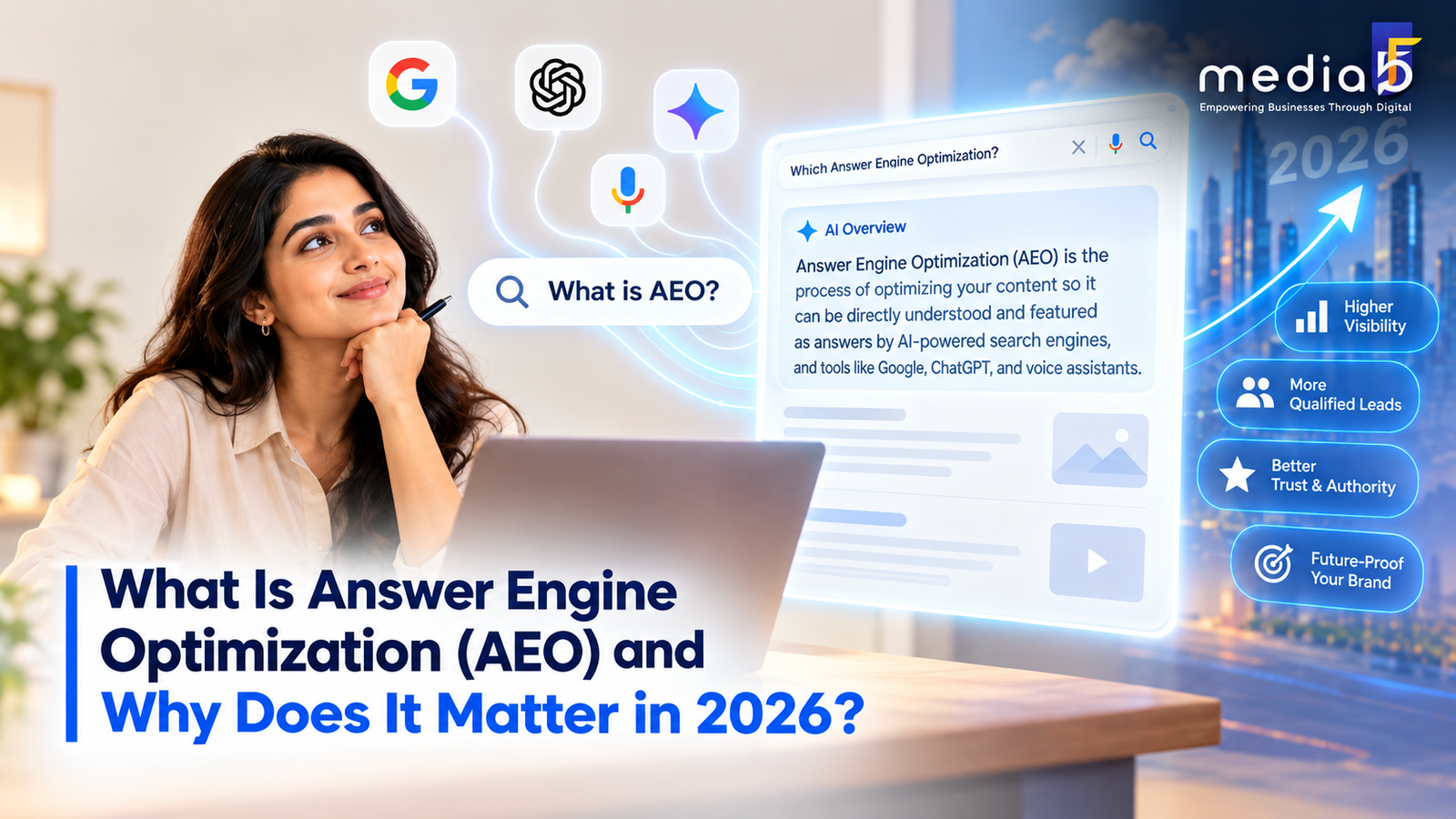
Answer Engine Optimization is the practice of structuring your content so AI-powered search tools and voice assistants can find it, understand it, and use it as the direct answer to a user’s question.
Traditional SEO aims to rank a link in a list of results. AEO aims to make your content the answer itself. Instead of competing only for clicks, you compete to be cited, quoted, and recommended.
You may also hear related terms such as Generative Engine Optimization (GEO), AI search optimization, LLM optimization, and voice search optimization. They overlap heavily, and together they describe the next stage of search engine marketing.
AEO vs. SEO: What’s the Difference?
AEO doesn’t replace SEO. It builds on it. SEO focuses on keywords, backlinks, and rankings, while AEO focuses on clear, question-based content that machines can easily extract and trust.
Strong technical SEO still matters, because answer engines pull from well-indexed, authoritative websites. But success now looks different. Instead of measuring only rankings and traffic, you also measure citations, brand mentions, and visibility inside AI-generated answers.
Why AEO Matters in 2026
Zero-click searches are now the norm. Featured snippets, AI summaries, and knowledge panels satisfy users without a single click. Even with stable rankings, your organic traffic can decline if you aren’t part of the answer.
Search has become conversational. People no longer type “best CRM.” They ask, “What’s the best CRM for a small business with a remote team?” Voice search and AI chat reward content that answers natural, long-tail questions directly.
AI platforms are the new discovery engines. Buyers now research products and compare services inside ChatGPT, Perplexity, and Gemini. Being mentioned there builds trust before anyone visits your site.
Authority decides who gets cited. Answer engines favor sources that show E-E-A-T: Experience, Expertise, Authoritativeness, and Trustworthiness. Clear authorship, credible sources, and consistent messaging make your brand far more likely to be surfaced.
8 Practical Ways to Optimize for Answer Engines
1. Answer Questions Directly and Upfront
Answer engines look for content that gives a clear, complete answer quickly. Start every section with a direct answer of about 40 to 60 words, then expand with context, examples, and data.
For example, if your heading is “What is schema markup?”, the first sentence should be: “Schema markup is a type of structured data code added to a webpage that helps search engines and AI models understand its content.” After that, explain how it works and why it matters.
This “answer first, explain later” format is what featured snippets, Google AI Overviews, and ChatGPT-style tools prefer to extract. Avoid long introductions, because they push your actual answer too far down the page.
2. Research the Real Questions Your Audience Asks
AEO starts with understanding intent. Instead of guessing, find the exact questions people type or speak. Good sources include:
- Google’s “People Also Ask” boxes and autocomplete suggestions
- AnswerThePublic, AlsoAsked, and Semrush’s question reports
- Reddit, Quora, and industry forums
- Customer support emails, chat logs, and sales calls
Group these questions by topic and turn them into question-based headings (what, why, how, when, who, which). Long-tail, conversational questions like “How do I get my business mentioned in ChatGPT?” are less competitive and match exactly how people use AI search and voice assistants.
3. Use Structured Data and Schema Markup
Schema markup gives search engines and AI models a machine-readable explanation of your content. It removes guesswork and makes your pages easier to categorize and cite.
- FAQ schema for question-and-answer sections
- HowTo schema for step-by-step guides
- Article schema for blog posts, with author and date details
- Organization schema for your brand name, logo, and social profiles
- Product and Review schema for ecommerce and service pages
Implement it in JSON-LD format, then test it with Google’s Rich Results Test. Clean, accurate schema is one of the strongest technical signals you can send.
4. Build Topical Authority with Content Clusters
Answer engines trust websites that cover a subject in depth, not sites with scattered, unrelated posts. A content cluster solves this.
Create one comprehensive pillar page (for example, “The Complete Guide to Answer Engine Optimization”), then publish supporting articles on subtopics such as schema markup, voice search optimization, featured snippets, and E-E-A-T. Link every supporting article to the pillar page and to each other using descriptive anchor text.
This structure shows search engines and AI models that your brand is a genuine authority on the topic, which increases your chances of being cited across many related questions.
5. Strengthen E-E-A-T Signals
E-E-A-T stands for Experience, Expertise, Authoritativeness, and Trustworthiness. AI systems prefer sources they can trust, especially for topics that affect money, health, or business decisions.
- Add detailed author bios with real credentials and links to their profiles
- Cite reputable sources and link to original research
- Publish case studies, original data, and first-hand experience
- Show reviews, testimonials, certifications, and awards
- Keep an accurate About page, contact details, and privacy policy
- Review and update older content regularly
The more clearly you show who is behind your content and why they are qualified, the more likely it is to be quoted.
6. Optimize for Voice Search and Natural Language
Voice queries are longer, more conversational, and often local. People say, “Which digital marketing agency is best for small businesses near me?” rather than typing “digital marketing agency.”
To capture these searches:
- Write in a natural, conversational tone with short sentences
- Use question-and-answer formats and FAQ sections
- Keep answers concise enough to be read aloud
- Include local terms and location details where relevant
- Claim and fully complete your Google Business Profile
- Make sure your name, address, and phone number are consistent everywhere
Voice assistants usually read out a single answer, so being that one answer matters even more.
7. Earn Brand Mentions Across the Web
AI models learn from the wider internet, not only your website. When your brand is mentioned consistently on trusted platforms, AI systems recognize it as a real, reliable entity.
Focus on earning mentions through:
- Guest posts and expert quotes in industry publications
- Podcast appearances and webinars
- Reviews on platforms like Google, Trustpilot, and G2
- Active, helpful participation on Reddit, Quora, and LinkedIn
- Digital PR, partnerships, and press coverage
Keep your brand name, description, and key details identical across every platform. Consistency helps AI tools connect the dots and recommend you confidently.
8. Maintain Strong Technical SEO Foundations
Even the best content can’t be cited if answer engines can’t access or understand it. Technical health is the base of every AEO strategy.
Make sure your site has:
- Fast loading speed and strong Core Web Vitals
- A mobile-friendly, responsive design
- HTTPS security
- A clean site structure with logical internal linking
- An up-to-date XML sitemap and a properly configured robots.txt
- No broken links, duplicate content, or crawl errors
- Proper heading hierarchy (one H1, then H2s and H3s in order)
Also check that you aren’t accidentally blocking AI crawlers, since that would stop your content from being used in AI-generated answers at all.
Common AEO Mistakes to Avoid
Avoid keyword stuffing, since AI models understand context and reward natural language. Don’t bury the answer beneath long introductions. Don’t publish thin or outdated content, because both depth and freshness matter. And don’t measure success by clicks alone, since AEO results also appear as citations, mentions, and growth in branded search.
How to Measure AEO Success
Track featured snippet and AI Overview appearances, brand mentions in ChatGPT, Perplexity, and Gemini, growth in branded search volume, impressions in Google Search Console, and the conversion quality of visitors referred by AI platforms.
How Mediaf5 Can Help You Win at AEO
Adapting to answer engines takes strategy, technical expertise, and consistent execution. Mediaf5 helps brands move beyond traditional SEO by combining content strategy, schema implementation, topical authority building, and AI search optimization into one cohesive approach. Whether your goal is to earn featured snippets, appear in AI-generated answers, or grow visibility across the evolving search landscape, Mediaf5 can help you build a future-ready digital marketing presence.
Final Thoughts
Answer Engine Optimization isn’t a passing trend. It reflects a lasting shift in how people find information and choose brands. In 2026, the winners won’t only rank on page one; they’ll be the brands AI trusts enough to quote.
Answer your customers’ questions clearly, structure your content for machines, and build real authority online. Ready to make your brand the answer? Connect with Mediaf5 and start optimizing for the future of search today.
A strong local SEO services Ahmedabad agency does not just execute tasks. They think strategically about your business alongside you.