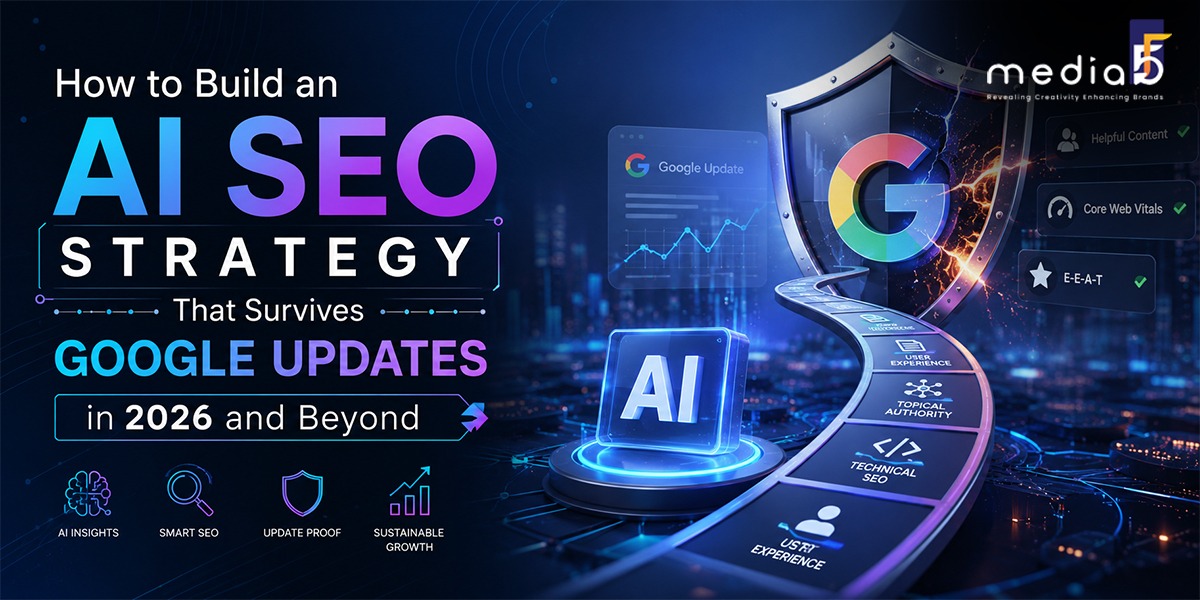
Let’s be honest about what happened to Search in 2026.
Google did not just release another algorithm update. It redesigned how search works from the ground up. AI Overviews now reach 2.5 billion users. AI Mode crossed 1 billion monthly users after Google I/O 2026. Background AI agents are beginning to browse the web on behalf of users without them ever typing a single query.
For businesses still running the same SEO playbook they used in 2022, this is not a wake-up call. It is a fire alarm.
But here is the thing. SEO is not dead. The version of SEO that chased keyword density, thin content, and link quantity is what died. The businesses that understand the shift and adapt early are the ones quietly building the most durable organic presence of their entire online history.
This guide is about how to do exactly that.
First, Understand What Actually Changed
The Google Core Update in May 2026 was the biggest ranking change in years. Almost 80% of the No. 1-3 results moved. The top 100 pages were completely removed from those that were recycled, AI-generated, or low effort.
At the same time, Google confirmed something important through its official guidance. AEO, GEO, and traditional SEO are not separate strategies. They work the same way as they do in a more advanced search environment. The basic stuff that works is still what Google likes: real skills, clean technical principles, and content that really helps people.
What changed is the bar. It got significantly higher.
The businesses that win in this environment are the ones investing in AI SEO services built around real depth, real authority, and real technical discipline.
Build on a Technical Foundation That Cannot Be Shaken
Every Google update since 2024 has punished one thing above everything else: websites that are technically broken underneath otherwise decent content.
A site that Google cannot crawl properly cannot rank. A site with poor Core Web Vitals signals a bad experience before the user reads a single word. Schema markup that is missing or incorrectly implemented means AI systems have no structured way to understand and cite your content.
This is where technical SEO services become the most important investment you can make before any content or link-building effort.
A proper technical audit covers:
- Crawlability and indexation health
- Page speed and Core Web Vitals across mobile and desktop
- Schema markup for articles, FAQs, and how-to content
- Internal linking structure and content hierarchy
- Redirect chains and duplicate content issues
Fix the foundation first. Everything built on top of it becomes more effective immediately.
Stop Writing Content. Start Building Authority.
Here’s a change that will set the successful businesses apart from those doing everything they can to maintain their rankings in organic search in 2026.
They began to consider topical ecosystems rather than individual blog posts.
Google’s May 2026 update aggressively rewarded topical depth. A business that owns five to eight deeply interconnected pieces of content around a single topic signals to both Google and AI systems that this is a genuine expert source. A business with 40 scattered blog posts on unrelated topics signals the opposite.
Pick three to five core topics that align with what your buyers actually search. Build a cluster of content around each one. Every new piece should strengthen an existing cluster, not float alone with no connections in or out.
This is the content architecture behind every strong search engine optimization services strategy in 2026. Not volume. Not frequency. Depth and structure.
What AI and SEO Actually Mean Now
The phrase “AI and SEO” gets used loosely. Let us be specific about what it means in practice.
Google’s AI systems, specifically the Gemini models powering AI Overviews and AI Mode, use a process called query fan-out. When a person types a question into the system, the system parses the question into dozens of sub-queries and retrieves answers from sources that it deems most credible and assembles an answer. Content is cited in that answer, or it is not.
What gets cited? Content with these qualities:
Original perspective. A neutral “what is digital marketing” article will not be chosen. A piece that includes your own data, your own experience, and your own point of view will.
Clear structure. You can include FAQ sections, write how-tos, use numbered lists, and have concise answer boxes for easier extraction and citation of your content by AI systems.
Verifiable expertise. Author credentials, cited sources, and real-world examples signal trust to both Google and AI models.
Information density over keyword density. The May 2026 update penalized over-optimization. AI Mode rewards pages that pack genuine insight, not pages that repeat the same phrase fourteen times.
The Role of Organic SEO in an AI-First World
Some businesses read about AI search and assume organic visibility no longer matters.
That misunderstands what is happening.
Organic SEO services are more important now than they were two years ago, not less. Here is why. AI Overviews pull their citations from indexed, well-optimized websites. If your website is not visible organically, it is also invisible to AI. If it is not trusted by Google’s traditional ranking signals, it will not be cited in AI-generated answers either.
Google confirmed this explicitly in their May 2026 optimization guide. Strong foundational SEO is the complete framework for AI visibility. There is no separate track.
The businesses being cited in AI Overviews and showing up in AI Mode responses are the ones that have been building solid organic foundations for years. That is not a coincidence.
Build an AI-Powered SEO Strategy, Not an AI-Dependent One
There’s an interesting point on here that most don’t see.
It’s wise and effective to leverage AI tools when doing content research, ideation, and performance analysis. It is now one of the quickest methods to lose rankings if you publish unedited AI-generated content at scale.
Google launched SynthID content verification for 2026 to help identify AI-generated content at scale. The second half of 2026 and beyond presents a real risk of negative (downside) consequences for brands leveraging unreviewed AI content.
The right approach for AI-powered SEO uses artificial intelligence as an input, not an output. Use it to identify keyword gaps, analyze competitor content structure, and scale research. Then let real expertise, human perspective, and original insight do the actual writing.
That combination is what Google rewards. That is what AI systems cite. That is what converts readers into customers.
Measure What Actually Matters
Old SEO measured keyword rankings. That metric is losing relevance fast.
When AI Overviews appear, the position one organic click-through rate drops significantly. Chasing a number-one ranking for a query where Google answers the question in an AI box above the results means your traffic numbers may still disappoint, even with the top position.
The metrics that matter in an AI-first search environment are:
Citation share. How often is your content being cited in AI-generated answers for your priority queries?
Organic traffic by intent. Are the people landing on your site from search in a position to buy, inquire, or convert? Traffic from the wrong queries is noise.
Engagement signals. Google uses session behavior, return visits, and bounce rates as quality signals in 2026. Users who stay, read, and return tell Google your content is genuinely useful.
Brand search volume. As AI systems shape discovery, users who trust your brand will search for you directly. Growing branded search is one of the clearest signals that your authority is compounding.
The Strategy in Plain Terms
Build a clean technical foundation. Structure content around topical authority, not individual keywords. Write with real expertise and original perspective. Use AI tools to work smarter, not to replace genuine insight. Measure the signals that reflect actual business impact.
That is an SEO strategy that does not just survive Google updates. It gets stronger with every one.
How MediaF5 Helps You Stay Ahead
The shift toward AI search rewards businesses that have the right team behind their organic strategy. Some agencies are still selling keyword reports from 2019. Teams that understand how search actually works in 2026.
MediaF5 is a creative, tech-driven agency that builds AI-powered SEO strategies designed for the search environment businesses are operating in right now. From deep technical audits to content architecture built for AI citation visibility, their approach connects every piece of SEO work to real business growth.
If your organic strategy needs to evolve for what search has become, MediaF5 is the right conversation to have.